The "O-Ring" Framework: Why Work Still Needs a Human
In the spring of this year, Anthropic published economic research, inspecting the effect of AI adoption on the labor market. Turns out that AI’s impact on the labor market was less than AI job-pocalypse doomsdayers predicted (including one prominent pessimist from Anthropic itself).
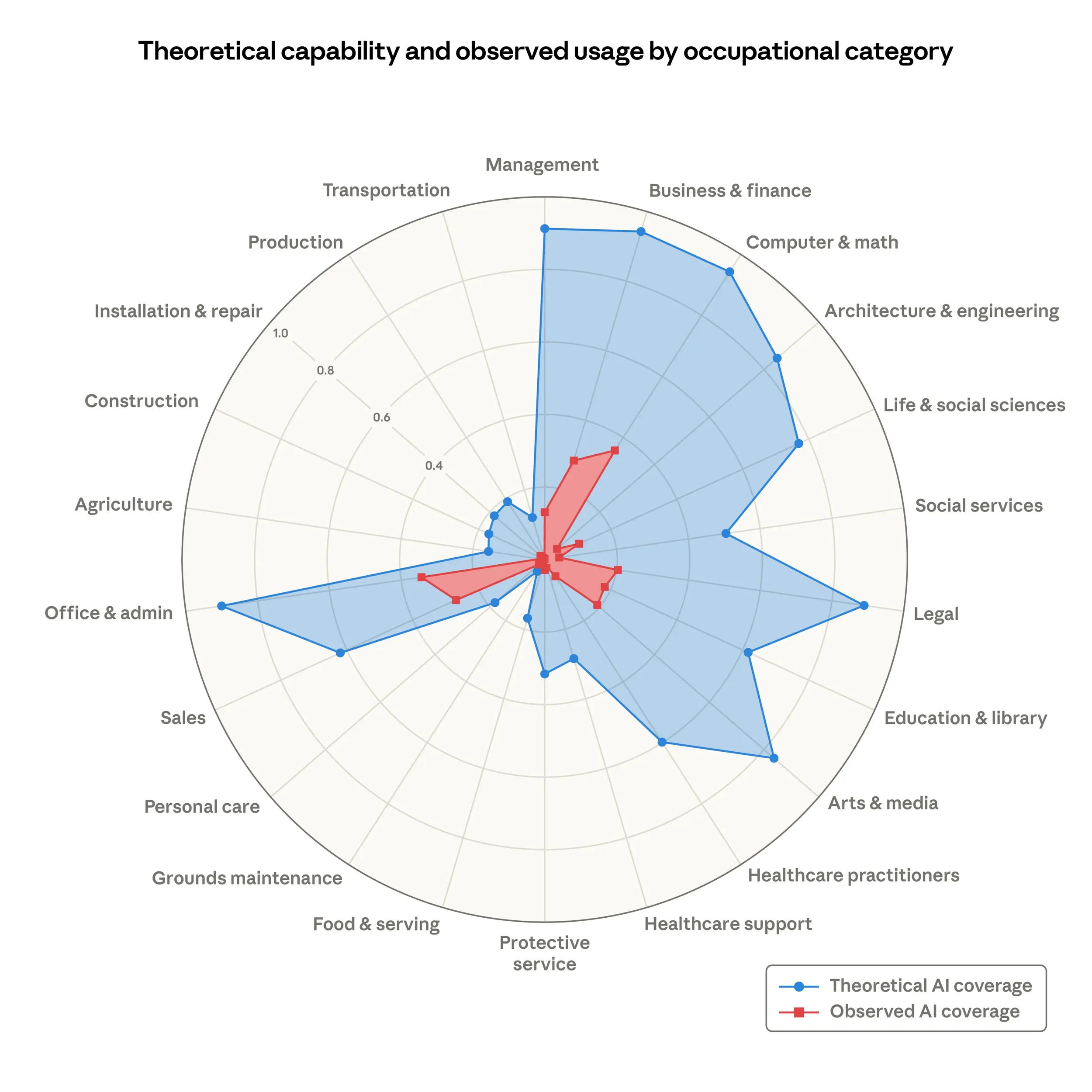
But the low labor impact wasn’t because of technology limitations. In fact, the Anthropic research suggests that AI is being underutilized. They identified a massive gap between what AI can theoretically do (blue) and what it is actually doing in the workplace today (red).
So why hasn't the "AI Revolution" led to mass unemployment and why is there such a gap between the red and the blue? Part of the explanation, quietly dropped into the Anthropic report, is based on the The O-Ring framework for job completion. The O-Ring framework suggests that job completion is a series of task completions. And in those cases where many (or all) of those tasks can be completely automated, without human interaction, that’s when you’ll see productivity gains and the full benefit of AI.
But many tasks, even those in the white collar space, have a necessary human-exclusive task baked into the process. Moreover, as AI capabilities advance, the "human" tasks are becoming more complex, high-stakes, and specialized. For example, because of legal and safety guardrails, AI can't yet authorize drug refills or "represent clients in court" without human oversight.
As AI grows so that its actual use eventually meets its potential, those human links in the ring will be more important. And the standards for human decision making will be higher because they will have more time and energy and focus on those strategic, high-stakes decisions of AI taking the lion's share of the tasks.
This is why at the AI Aptitude Institute we think AI literate employees need to master the tasks AI can't do. For example, our Workforce AI Literacy Assessment identifies the specific "Abilities" (problem-solving and critical thinking) that allow humans to reason alongside AI rather than being entirely depend on it.
Three assessment domains help diagnose and train teams in areas where the human link still matters:
Quality & Risk Management: Mastering output verification, evaluation, and failure mode mitigation.
Responsible AI Practice: Navigating the ethics of attribution, copyright, and critical reflection to avoid over-reliance.
Applied Workflow Design: Understanding when AI should augment a task vs. when a human must lead.
AI is far from reaching its full theoretical potential in the workforce. But, despite low adoption and integration rates, we’ve still seen AI impact the labor force (such as the slowing of junior talent exposed roles). This signals that the red will one day catch up to the blue and now is the time to build AI literacy.
Learn more here to help ensure your workforce remains the strongest link in the chain.